














































DronePilotsAruba.com · Practical guides
Drone paperwork in Aruba: separate registration, access and flight authorization
Published 5 November 2026

Different documents answer different questions. Use current official aviation and site-authority sources, and do not turn an operator profile, foreign certificate or equipment form into a promise that a particular flight is allowed.
Identify the question each document answers
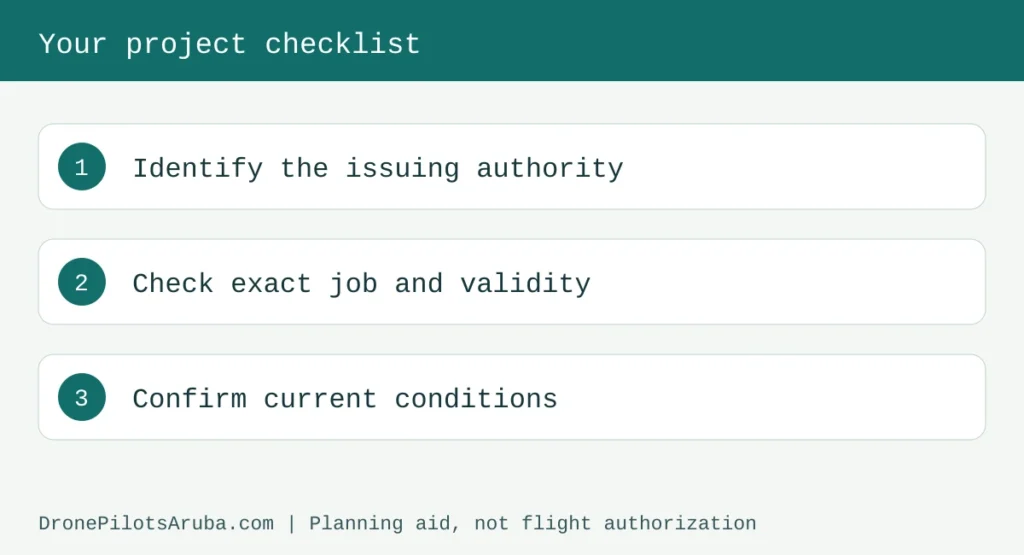
An equipment form, a business registration, a training record and a job-specific authorization serve different purposes. Ask the operator to explain which current requirement each document addresses and which authority issued it. Keep the proposed aircraft, responsible person, location, dates and purpose together when checking scope. A document that names another aircraft, company or period may not support your assignment. This guide is a planning framework rather than a flight-clearance service. It does not publish a universal altitude, radius or permission rule that could be mistaken for approval of your site.
Use the aviation authority for operational requirements
Confirm current operational requirements directly with Aruba’s Department of Civil Aviation through its official channels before planning a flight. Its public website could not be retrieved during our 5 November 2026 editorial check, so this article does not reproduce an unverified rule table or promise a processing time. Do not substitute another country’s aviation rules or a traveller’s experience for an Aruba decision. Ask the operator for current official instructions and the actual written authorization where required. Resolve uncertainty before committing to a flight-dependent deliverable, and recheck when the location, date or operational scope changes.
Do not confuse telecommunications paperwork with clearance
Aruba’s telecommunications regulator publishes a drone importation and registration form in its official e-forms directory. Use that source for its own equipment-related process and confirm which current form applies. Completing equipment paperwork does not establish that a particular flight has aviation or landowner authorization. If bringing equipment into Aruba, ask the responsible authorities about the current requirements rather than assuming a provider’s older trip covers yours. Keep administrative responsibilities explicit in the quotation so that neither client nor operator silently assumes the other party has handled them.
Check the place as well as the airspace
Property entry, filming consent and aviation authorization should be checked separately. The official airport regulations address commercial activity and non-private recording on airport premises. Their scope should not be stretched into a general island-wide filming rule or interpreted as permission to fly near the airport. Ask the relevant site authority what applies to your actual location and activity. A location name in an operator’s coverage list means only that the provider says it serves that area; it is not a map of approved take-off points.
Keep an auditable project record
Save the original source, date checked, named party, validity period and any conditions. Read restrictions rather than just the heading of a document. Ask who will confirm the final status before the assignment proceeds and who can stop the operation if circumstances change. Never publish private document numbers in a directory listing. Our operator-selection guide and location-planning checklist help organize the remaining questions. DronePilotsAruba.com does not certify operators, issue permissions or guarantee that a requested flight can take place.